




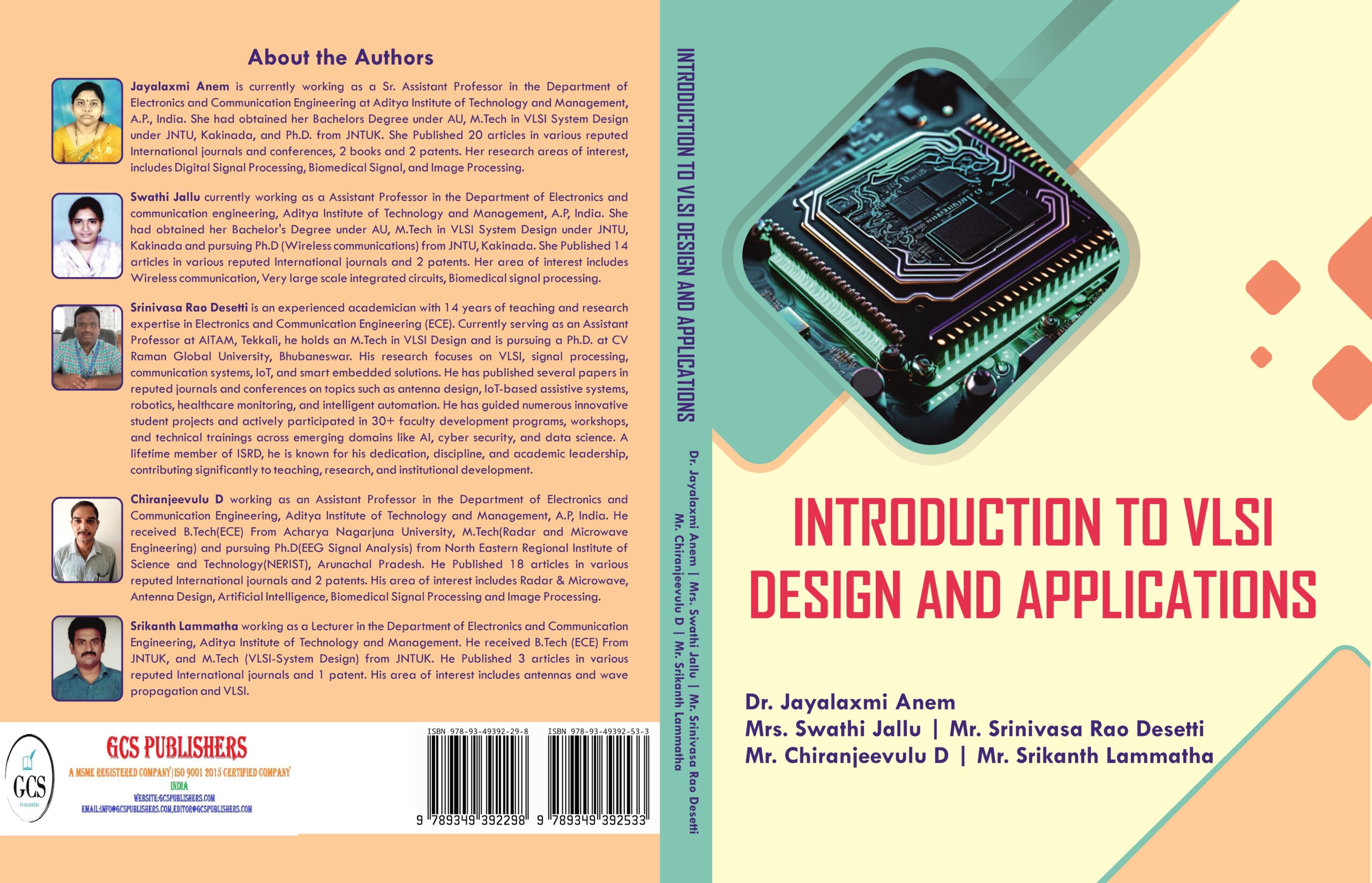
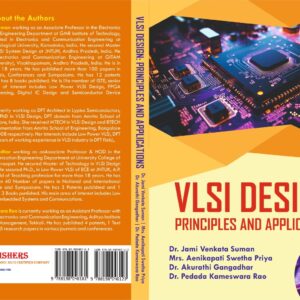
It gives us immense pleasure to present this book, Introduction to VLSI Design and Applications, authored collectively by the faculty of the Department of Electronics and Communication Engineering, Aditya Institute of Technology and Management (A), Tekkali–532201, Andhra Pradesh. This volume has been conceived and prepared with the intent of providing students, researchers, and practicing engineers with a balanced introduction to the concepts, methodologies, and applications of Very Large-Scale Integration (VLSI) design.
The field of VLSI has transformed the landscape of modern electronics, enabling the integration of billions of transistors onto a single chip. This rapid advancement has paved the way for powerful processors, compact systems, and intelligent devices that define contemporary technology. In this book, we endeavor to bridge theoretical principles with practical design perspectives so that learners gain both conceptual clarity and applied skills.
The text has been developed to address the academic requirements of undergraduate and postgraduate students, while also serving as a reference for researchers and professionals who are interested in the evolving domain of VLSI systems. Special emphasis has been placed on explaining the foundational aspects of digital design, CMOS technology, design methodologies, and their real-world applications. At the same time, case studies and application-oriented discussions highlight how VLSI is shaping domains such as communication, signal processing, embedded systems, and artificial intelligence.
What distinguishes this book is its collaborative spirit. Every chapter is a product of the collective expertise of faculty members from our department, each bringing their own specialization and teaching experience into the text. This multi-author approach enriches the content, offering readers a diversity of perspectives, pedagogical styles, and practical insights rooted in our sustained academic and research practices.
We are confident that this book will not only supplement classroom learning but also serve as a stepping stone for advanced study and innovation in semiconductor technology and integrated circuits. It is our hope that readers find this work rewarding and that it inspires them to explore, innovate, and contribute meaningfully to the dynamic field of VLSI.
We express our deep gratitude to our management, colleagues, students, and well-wishers of Aditya Institute of Technology and Management, Tekkali, for their encouragement and support throughout the preparation of this manuscript. Without their guidance, this collaborative effort would not have been possible.
Finally, we dedicate this work to our students—the true motivation behind this endeavor—whose curiosity and enthusiasm continuously inspire us to teach, learn, and create.




Reviews
There are no reviews yet.