

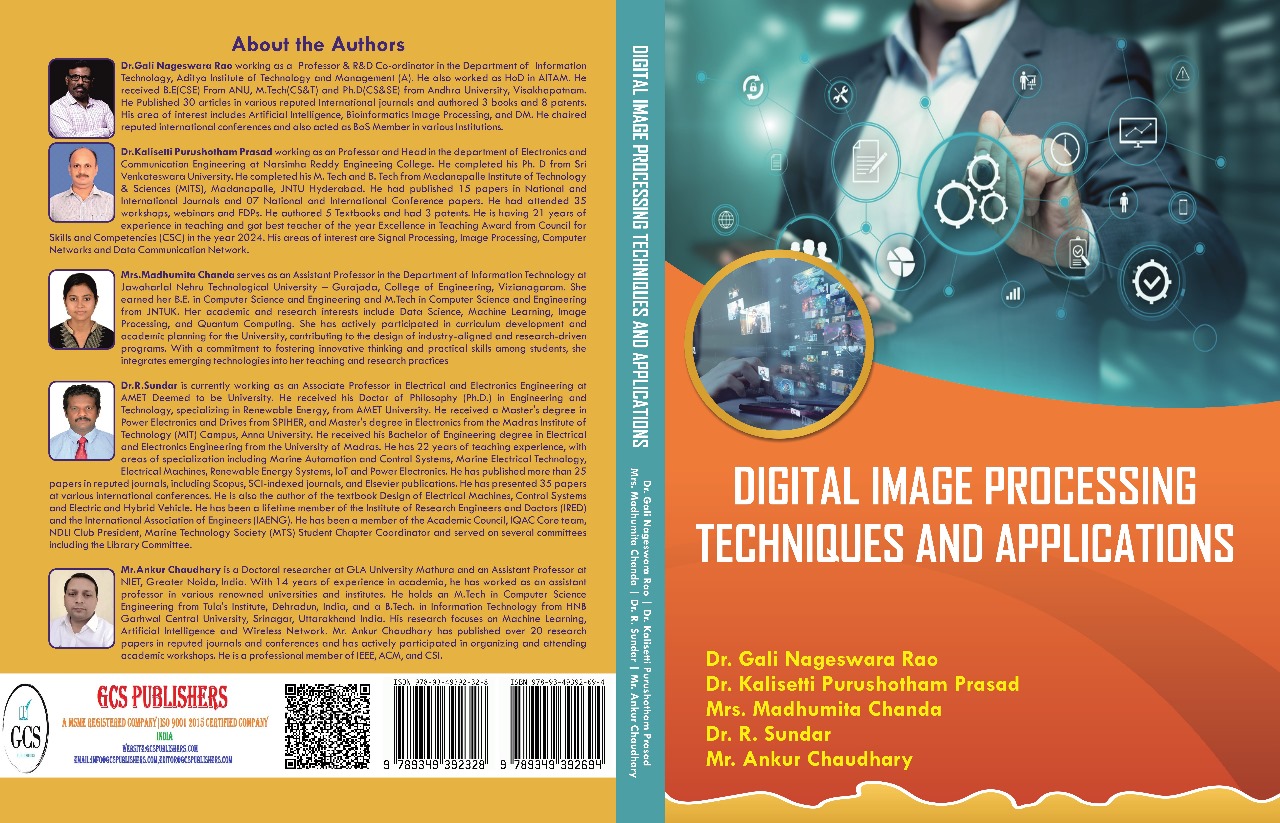
The rapid growth of digital technologies has transformed the way we capture, transmit, analyze, and interpret visual information. Among these advancements, digital image processing (DIP) has emerged as a pivotal discipline, influencing diverse domains—from healthcare, remote sensing, and forensics to industrial automation, agriculture, and social media. The sheer breadth of applications underscores the importance of providing a comprehensive, application-oriented resource for students, researchers, and practitioners alike.
This edited volume, Digital Image Processing: Techniques and Applications, represents the collective expertise and scholarly contributions of multiple authors across varied domains of image processing research. Each chapter has been carefully structured to integrate fundamental concepts, advanced techniques, and emerging trends with practical applications. The collaborative nature of this book ensures a multi-perspective understanding, where theoretical insights are reinforced with experimental case studies and real-world implementations.
The book begins with chapters that introduce the foundational principles of digital image representation and enhancement, before progressing into advanced methodologies including segmentation, feature extraction, image compression, pattern recognition, and deep learning-based approaches. Special emphasis has been placed on application-driven perspectives, demonstrating how these techniques are employed in medical imaging, satellite image analysis, security systems, biometric identification, and multimedia technologies.
One of the unique aspects of this volume is its multi-author framework. Each contributor brings their distinct area of expertise, ensuring diversity in academic thought and research orientation. This collective synergy makes the book not only a structured reference guide but also a platform for intellectual exchange. Readers will find the chapters interconnected, yet self-contained, allowing the book to be used flexibly as a comprehensive course reference, a research companion, or a professional handbook.
We envisage this work as a bridge between theory and practice, supporting students, academicians, and engineers in strengthening their conceptual clarity while fostering innovative applications in the field. It is our sincere hope that this book serves as an inspiration for further research and development in digital image processing, ultimately contributing to technological progress and societal well-being.
We extend our gratitude to the contributing authors for their scholarly dedication, to our colleagues and reviewers for their constructive guidance, and to our families for their encouragement throughout this endeavor. Most importantly, we thank the readers for their interest—we believe that your engagement with this book completes the true purpose of our collaborative effort.








Reviews
There are no reviews yet.