
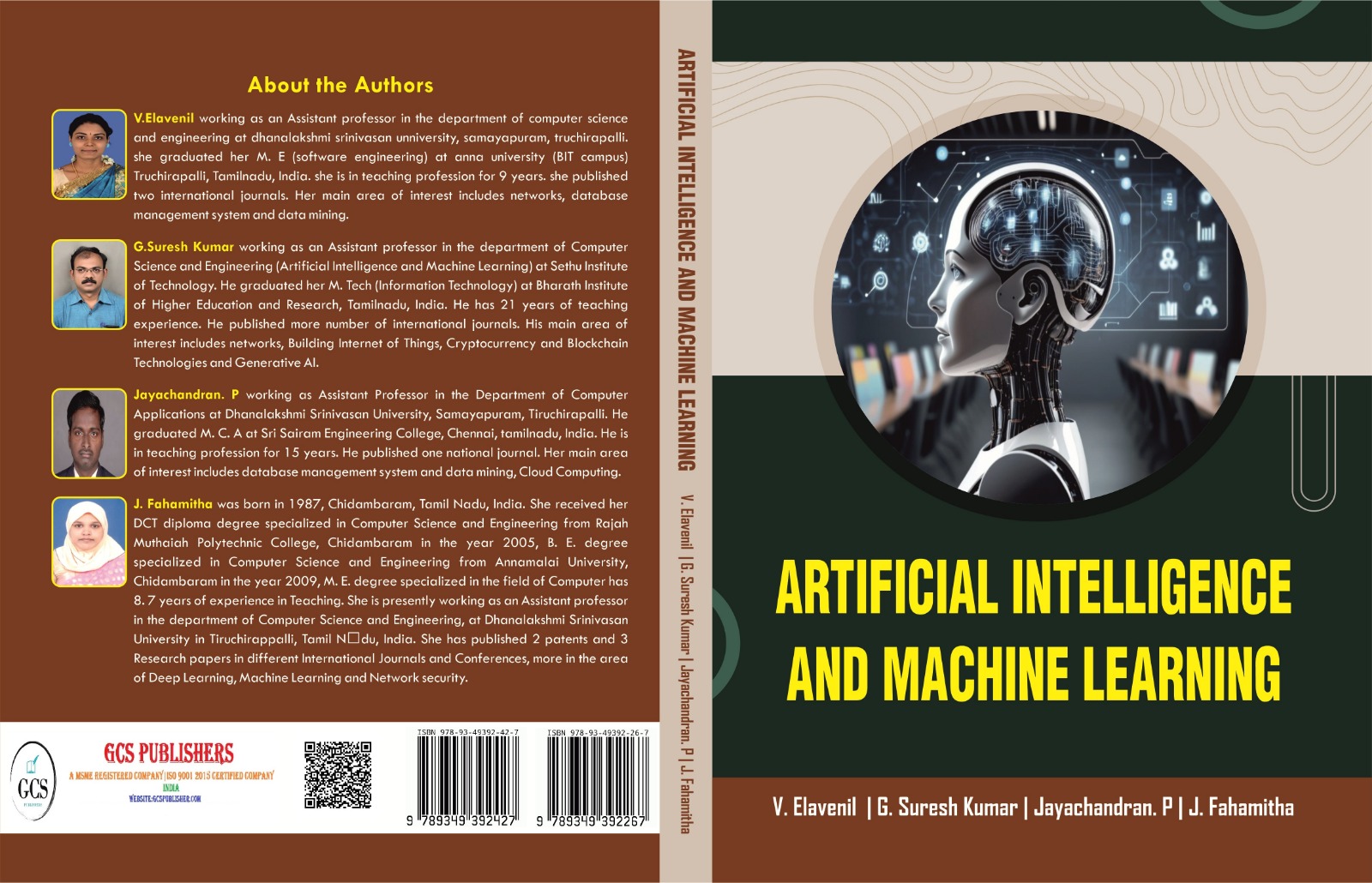
Artificial Intelligence (AI) and Machine Learning (ML) have rapidly transformed from theoretical research domains into powerful technological drivers shaping modern society. From intelligent virtual assistants and recommendation systems to autonomous vehicles and medical diagnostics, AI and ML technologies are redefining industries, governance, education, healthcare, finance, cybersecurity, and smart infrastructure. The growing demand for intelligent systems has made AI and ML essential subjects in engineering, computer science, and interdisciplinary research.
This multi-author book, Artificial Intelligence and Machine Learning, is designed to provide a comprehensive, structured, and application-oriented understanding of the core principles, mathematical foundations, algorithms, models, and real-world implementations of AI and ML. The book combines theoretical depth with practical insights, ensuring that students, researchers, academicians, and industry professionals can bridge the gap between concepts and implementation.
The objective of this book is threefold:
- To build strong foundational knowledge in Artificial Intelligence, including problem-solving techniques, search strategies, knowledge representation, and reasoning.
- To present Machine Learning models systematically, covering supervised learning, unsupervised learning, reinforcement learning, and deep learning.
- To explore emerging domains such as Generative AI, Explainable AI (XAI), Edge AI, Federated Learning, Blockchain integration, and AI Ethics.
This book is organized in a progressive manner. It begins with an introduction to AI concepts and intelligent agents, followed by search algorithms, probability-based reasoning, and optimization techniques. The Machine Learning section includes regression, classification, clustering, ensemble models, and neural networks. Advanced chapters cover deep learning architectures, natural language processing, computer vision, generative models, and responsible AI frameworks. Each chapter integrates mathematical formulations, algorithmic models, case studies, diagrams, and practical examples to enhance conceptual clarity.
A distinguishing feature of this book is its multi-author perspective. Each contributing author brings academic expertise, research experience, and industry exposure, ensuring diverse viewpoints and enriched technical depth. The collaborative effort allows the book to cover both foundational theories and emerging innovations in AI and ML.
This book is particularly suitable for:
- Undergraduate and postgraduate students in Computer Science, IT, AI & ML programs
- Researchers and scholars exploring advanced AI models
- Industry professionals seeking structured learning
- Competitive examination aspirants and certification candidates
We acknowledge the rapid evolution of Artificial Intelligence and Machine Learning technologies. Therefore, this book integrates contemporary tools, frameworks, and real-world applications aligned with current academic curricula and industry standards.
We express our sincere gratitude to the contributing authors, reviewers, academic colleagues, and the publishing team for their valuable support and commitment in bringing this book to completion. Their collective effort has ensured technical accuracy, clarity, and relevance.
We hope this book serves as a meaningful academic resource and inspires readers to innovate responsibly in the evolving world of Artificial Intelligence and Machine Learning.





Reviews
There are no reviews yet.